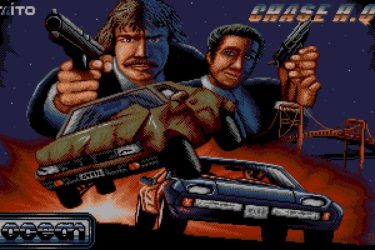
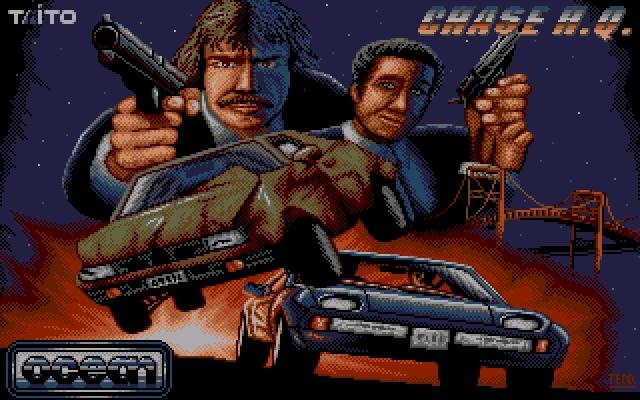
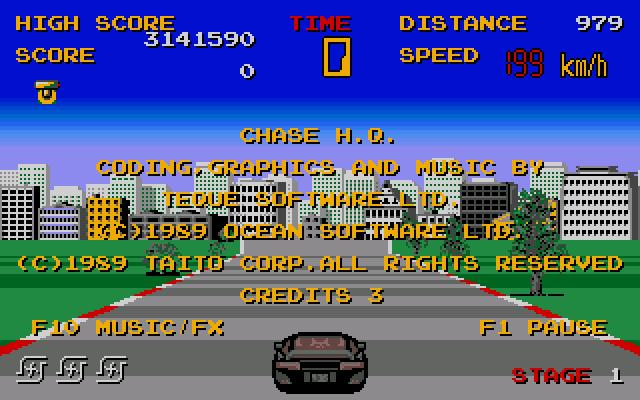
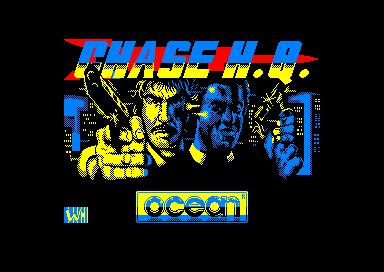
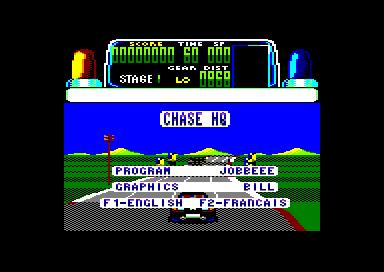

Chase H.Q. (チェイスH.Q., "Chase Headquarters") is a 1988 arcade racing game, released by Taito. It is sometimes seen as a spiritual successor to Taito's earlier Full Throttle. The player assumes the role of a police officer named Tony Gibson, member of the "Chase Special Investigation Department." Along with his partner, Raymond Broady, he must stop fleeing criminals in high-speed pursuits.
The game was well received in the gaming industry, resulting in three arcade-based sequels being released: Special Criminal Investigation (1989), Super Chase: Criminal Termination (1992) and Chase H.Q. 2 (2007). Two spin-offs were also released: Crime City (1989) and Quiz H.Q. (1990).
The game was ported to many home computers by Ocean Software in 1989, including versions for the ZX Spectrum, Amstrad CPC, Commodore 64, Amiga and Atari ST. Taito produced versions for the Family Computer (1989), Game Boy (1990), Master System (1990), TurboGrafx-16 (1990) and Game Gear (1991). It was released for PlayStation 2 in Japan in 2007 as part of Taito Memories II Volume 2.

Chase H.Q. (1988)
⭐ Rating Breakdown
No rating available yet
Review data for this game has not yet been added to the SEGA Universe rating system.
Commuunity Reviews & Discussion
No community reviews yet
Be the first to rate and review Chase H.Q. (1988) on SEGA Universe.
Write the First ReviewRelated Articles
Reviews & Discussion
Chase H.Q. (1988) does not currently have an overall rating.
Review data for this game has not yet been added to the SEGA Universe rating system.
SEGA Universe ratings are built from the review sources available for each game.
Community reviews are submitted by SEGA Universe members and use a 5-star rating system.
SEGA Universe reviews are editorial reviews written specifically for the site and may contribute to a game’s overall score.
For games originally released on classic SEGA platforms such as the Master System, Mega Drive (Genesis), Saturn and Dreamcast, historical magazine reviews may be used to provide contemporary critic scores from the time of release. These scores are normalised to a 100-point scale before being included in the rating.
For newer releases, Metacritic scores may be used when historical critic reviews are not available.
Not every game uses the same review sources. Some games may only have community reviews, while others combine community reviews, SEGA Universe reviews and critic scores.
Each available review source contributes equally to the final rating.
This database is built using contributions from SEGA Universe and information provided by RAWG Video Game Database
It is continually being improved, and we welcome feedback from the community. If you notice an error, missing information or would like to suggest an update, please contact us at thesegauniverse@gmail.com